

Everyday Normal
Winn called two days into something I was pretending was still a choice.
I stared at the name on the screen as if it might change into someone more appropriate for my condition. Like my mother. Or a nurse. Or a friend with a tranquilizer gun.
Winn had a talent for calling at the exact moment a person became legally unfit to represent themselves.
I answered on the third buzz because I had rules about eagerness.
“Hey,” I said. My voice came out normal, which surprised me.
“Where are you,” Winn said. Not a question.
“Fainting couch,” I said. “Relaxing.”
He paused.
I could hear a bar behind him, or a street, or a room full of people starting their own journey like mine.
“Relaxing,” he said. “You sound… serene.”
“I’m a serene person,” I said. “You know that.”
“That is hilariously untrue.”
I sat up, because lying down felt like admitting guilt. My body was a bag of loose parts. Two days without sleep made my thoughts feel like they were being printed on an old ribbon printer.
“I’m in the East Village,” Winn said. “I’m starving. I want a fried chicken sandwich.”
“Fried chicken is…” I said, then stopped because I could feel myself trying to complete the sentence the way you try to finish a crossword when you don’t know the answer.
“Fried chicken is fine,” I said. “In theory.”
“There’s a tiki spot,” he said.
“Heard.”
“I’m a bachelor tonight,” he said. “If you don’t come meet me, then I’m going home to eat a hot dog over the sink.”
“I’m a person,” I said, too quickly.
Winn laughed once, short.
“Sure,” he said. “Come be one with me.”
I looked like I had spent two days trying to solve a mystery that turned out to be myself. I was still wearing my eating shirt. My face was too alert.
I decided the light in the room had a tone I didn’t care for.
“I can be there,” I said, and then added, “soon.”
“Perfect,” Winn said. “It’s going to be great.”
“How?” I asked.
“Don’t do that,” he said. “You know what I mean. Just get here.”
Then he hung up, like a person with trust.
I set my phone down and stared at it, hoping it would give me instructions. It did not.
I stood up and felt bled white. My heart was doing a frantic drumline thing. I put my hand on the kitchen counter. The counter was a friend who didn’t ask questions and always gave the right answer.
I told myself my morale was boosted to capacity. I told myself it was enough.
My body did not accept the terms. I rationalized it as needing some pep to stay awake, which felt responsible.
I leaned over to boost morale. The mirror watched me with the blank patience of glass. I looked like I was pretending to be enthusiastic.
“Okay,” I said aloud. “I am normal. I am fine.”
Dressed. Shoes. Keys. Door. Wrong key. Right key. Locked.
I forced myself to take the stairs assertively, one step at a time.
Outside, Cobble Hill was thriving. Strollers with babies. Parents holding babies. Babies wearing tiny hats. Couples holding hands. Probably planning babies.
I walked to Bergen station fast, my legs performing confidence. The air was cold and honest. It made my face feel borrowed.
On the platform, a kid ate a bagel like someone who had never once interrogated his social perception. A woman scrolled her phone, unafraid of information. A man in headphones stared into the tunnel, waiting like a Beckett character.
The F train screeched in like it had other more important matters.
I got on and performed belonging.
Each stop name sounded like an accusation. Every advertisement looked like a dare. I caught my reflection in the window. I looked like an ad for antidepressants.
I winked at myself for confidence.
My phone buzzed.
Winn: Close?
I typed: yes
I was not close. I was in motion. Motion was close enough.
I got off at 2nd Ave. The night felt especially East Village: wet, restless, half-artistic, half-feral. The sidewalks looked freshly baptized. People leaned into doorways and smoked like they were trying on a concept called Smoking.
The bar sat there like a stolen idea with a sign.
Inside, it felt like it had been designed by someone who believed in irony as identity. The kind of place that served tropical drinks in cheap glassware while a television above the bar played Disney films. A room with rules meant to keep it relevant.
I felt comfortable immediately.
It was dim. Concrete. Wood. Plants fighting for their lives. The air was citrus cleaner and frying oil.
Winn was at the bar, half-turned toward whatever was next. That was Winn. A person taking it all in while also looking at the future.
“You made it,” he said.
He wore a jacket that made him look like he’d strolled into adulthood with a backup plan. His hair was good in a way that felt like a challenge.
“Great,” I said.
He raised an eyebrow.
“You look great,” I said. “Like you meant it.”
“You eating?” he asked.
“I’m here,” I said.
“That’s not an answer.”
“You’re not an answer.”
“Two sandwiches,” he said to the bartender, then to me: “Hot breast?”
“Sure,” I said, like my mouth had any authority.
We ordered tiki drinks in glasses that looked like props. They had paper umbrellas and crushed ice, a sweetness that covered the alcohol like a smile covers a grudge.
I took a sip of my blue drink. “See you tomorrow.”
Winn tried his. “They don’t hold back on the booze.”
The first bite was enough. The chicken was hot and crisp and brined into submission. The bread was soft. The sauce stung politely. It was everything my body wanted and nothing my mind deserved.
I chewed like a person who respected poultry.
“See,” he said. “This is why I called you.”
“I’m emotional,” I said.
Winn laughed.
“You’re also on something.”
“I’m always on something.”
“Your eyes are moons.”
“I’m a little tired.”
Winn raised both eyebrows.
“A little,” he said.
I nodded once, too hard.
“You want to do something after this?” he asked.
“Probably,” I said.
“There’s a brand thing,” he said. “A certain amaro we all know and love. One of those parties where everyone pretends it’s not a sales pitch.”
“I love pretending.”
“It’s close,” he said. “It’ll be fun. Free drinks. Food. People I know that you don’t.”
“Wonderful,” I said. “I just need to make a quick jaunt to the facilities.”
“I thought you might.”
I took another bite of chicken and went to boost morale in the bathroom. When I came back, Winn was settling up the check.
Outside, the air slapped my face and made me feel guilty.
We walked. Winn moved with direction. I followed without any.
The event space was nearby, in one of those buildings that looked abandoned from the outside, and expensive on the inside. A door that didn’t want you. A buzzer. A small sign in a font that implied minimalism.
Winn flashed an email at a person with a clipboard. He smiled like he’d known her in another life. He said something I couldn’t hear, and she laughed like she did.
Then he turned back to me.
“We’re in,” he said.
Inside, the place was lit like an art installation. Not bright, not dark—just enough light to make everyone try a little harder. There were surrealist paintings. Sculptures of big cats. A wall of projected visuals pulsing quietly, like the room’s heartbeat.
Music played at a volume designed to make you lean in close to strangers.
Brand reps in side rooms, tables of bottles with little signs. They poured with casual generosity, like it was nothing to hand someone a thirty-year-old glass of whiskey.
Someone offered me a drink that tasted like bonfire. It made my mouth feel like it had joined a club.
I followed Winn through the space like an overwhelmed child.
I caught myself wanting to run to the bathroom to boost morale. I didn’t need it. My body was used to punctuating time with it.
I didn’t want to be that person.
The bathroom was in a hallway that smelled like new paint. I looked at myself under fluorescent light that did not care about my story.
My face looked alive in a way that felt inappropriate.
I washed my hands for too long. Went back and pretended I was away being normal.
Winn found me and put a drink in my hand.
We walked to the food area and I had to stop because it was breathtaking. Charcuterie arranged like art. Sushi laid out like a last wish. Little pastries. Little bowls of mousses. A whole section that appeared to be dedicated to bread.
I watched a man in a blazer take a piece of cheese with the reverence of someone accepting a medal.
I leaned toward Winn.
“Are we supposed to act natural?”
Winn looked at me.
“Not you,” he said.
“Thank you,” I said.
We drifted. We drank. We listened to people talk about brands like brands were friends. I overheard a woman say, “It’s really about storytelling,” and felt my soul briefly leave my body.
I realized I had been awake long enough that my brain had started to loop. I kept thinking the same thought: This is happening. This is happening. This is happening.
Winn touched my elbow.
“Wanna bounce?” he asked.
“This is happening,” I said. “I’m thriving.”
“You’re vibrating,” Winn said.
“It’s my aura,” I said.
“Let’s go,” he said.
“Yes,” I said, immediately.
We moved toward the exit.
As we walked by the food table, I saw them.
Chicken tenders.
Not polite ones. Not little ones. Not artisanal nuggets.
These were tenders the length of a forearm. Golden and perfect, as if someone had asked, What if comfort was literal? What if it had weight?
Winn looked at me. I looked at Winn.
No discussion.
We each grabbed one like it was being issued for survival.
Hot. Ridiculous. Greasy with righteousness. The breading had a crust that made you believe again.
We walked out holding them like swords.
At the door, a bouncer saw us.
His face showed his brain trying to work out a moment the rulebook didn’t cover.
He looked at the tenders.
He looked at us.
We were leaving. We weren’t stealing alcohol. We weren’t causing trouble. We were just taking chicken from an alcohol party.
His mouth opened, then closed.
He sighed, defeated by the absurdity. “Go ahead.”
We nodded to him as we passed.
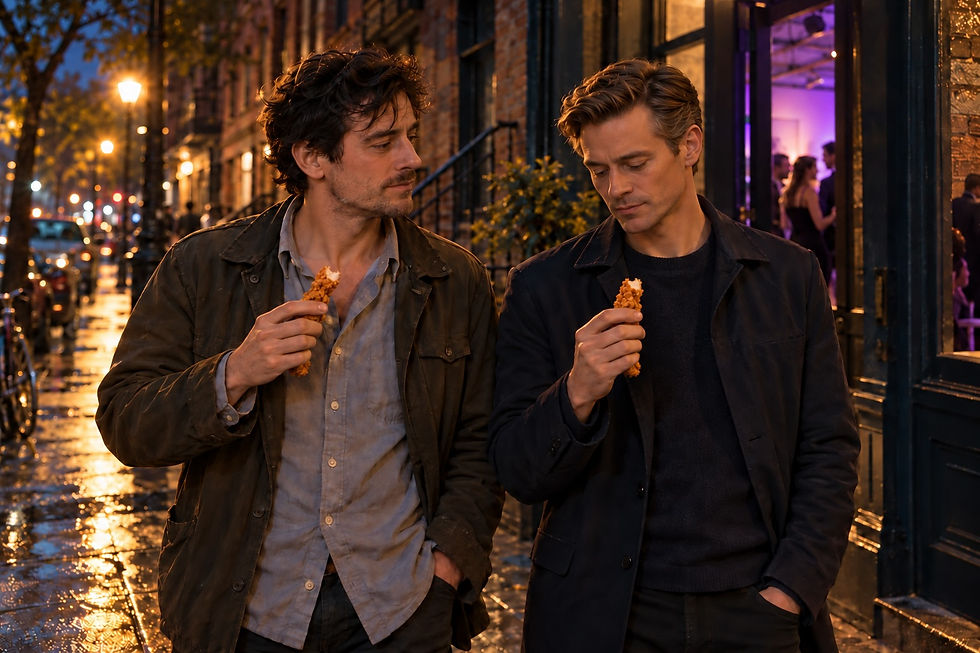
Outside, the night was wet and real. The streetlights made the grease on the tenders shine like lacquer.
We stood on the sidewalk on Avenue C, two grown men holding enormous pieces of fried chicken.
We took bites at the same time.
It was transcendent. Not in a spiritual way. In a body way. Everything in me lined up and faced the same direction for the first time in forty-eight hours.
It was crisp, hot, salty, tender enough to make you joyful. Then sad. Then angry.
The breading shattered, then disappeared. The inside was juicy and clean and honest.
I forgot I was trying to be normal.
Winn chewed and closed his eyes.
“Oh my God,” he said.
“Agreed,” I said.
We ate in silence, both of us reverent, like we’d stumbled into an epiphany, and it was fried.
When we finished, Winn wiped his hands on a napkin he’d also pilfered. He was a professional.
“I’m going north,” he said.
“I’m south.”
He stepped in and hugged me and meant it.
“You made it,” he said.
“I’m a real boy,” I said.
Winn laughed.
“Go home,” he said.
“I’m going,” I said. “I’m leaving early.”
“Close enough.”
“Love you,” I said, turning around to not hear his answer.
I walked to 2nd Ave. station. At the turnstile, I forgot how to tap my phone. Then I remembered, loudly.
I stood on the platform and tried not to sway.
I texted Winn, I’m haunted by that chicken tender.
He replied instantly, Why didn’t we grab two?
The F train arrived like it had always been coming.
I got on. I sat down. Nothing happened. I stared at my hands. They looked like hands. They looked like they belonged to a person.
A normal thought.
Jonathan Daniel Gardner is originally from Asheville, North Carolina, and currently lives and writes in Brooklyn, New York. Though he can only manage a neutral American accent, a “y’all” will escape him on occasion as proof of origin. His work has appeared in Change Seven Magazine, Maudlin House, and Avalon Literature and Arts Magazine, with pieces forthcoming in Blood+Honey and Beyond Words. He holds a degree in Creative Writing from The New School, works at a cocktail bar, and is currently completing his first novel, In Moon I Keep You. Find him at: Instagram.com/jonathandanielgardner
Read more like this:

Comments